

Subvision Robotics
City:
Vancouver, BC
Founded:
March 2024
Sector:
Oceantech

Charting a New Course for Maritime Maintenance
The moment a commercial vessel enters the water, it faces a costly adversary: biofouling. The accumulation of algae, barnacles, and marine microorganisms on a ship’s hull acts like an underwater anchor, drastically increasing hydrodynamic drag. Even a thin, 0.5 mm layer of bacterial slime can force a vessel to burn up to 25% more fuel to maintain its speed. Historically, the maritime industry has handled this through reactive crisis management—waiting until heavy growth takes hold, then hiring commercial divers to scrub the hull with aggressive mechanical brushes.
It’s a fundamentally broken cycle. Abrasive scrubbing strips away expensive protective coatings, forcing operators into premature drydocking. Worse yet, reactive cleaning discharges heavy biological waste and microplastics directly into local port waters, causing severe compliance bottlenecks as international environmental regulations tighten.
Instead of trying to build a better brush to clean up the mess, Burnaby-based Subvision Robotics is rewriting the maritime playbook entirely. The clean technology startup is introducing a prevention-first paradigm to the shipping sector with ZIMA: an autonomous subsea robotic platform that patrols a ship’s hull like a dedicated maintenance crew. Utilizing close-range UV-C light treatment during short, highly repeatable passes, ZIMA targets and neutralizes early-stage organic growth before visible biofouling can ever establish a foothold. It’s an elegant operational shift: treat hull maintenance like brushing teeth rather than waiting around for a cavity to form.
The financial and environmental stakes of this hidden problem are massive. According to the International Maritime Organization (IMO), severe hull fouling can spike a ship’s greenhouse gas emissions by up to 55%. Furthermore, fouled hulls account for the vast majority of accidental invasive species transfers worldwide, permanently destabilizing delicate marine ecosystems. By transforming an aggressive, occasional scrubbing event into a predictable, non-destructive preventative service, Subvision Robotics is simultaneously protecting a vessel’s bottom line and defending the health of our oceans.

Turning the Tide on Biofouling
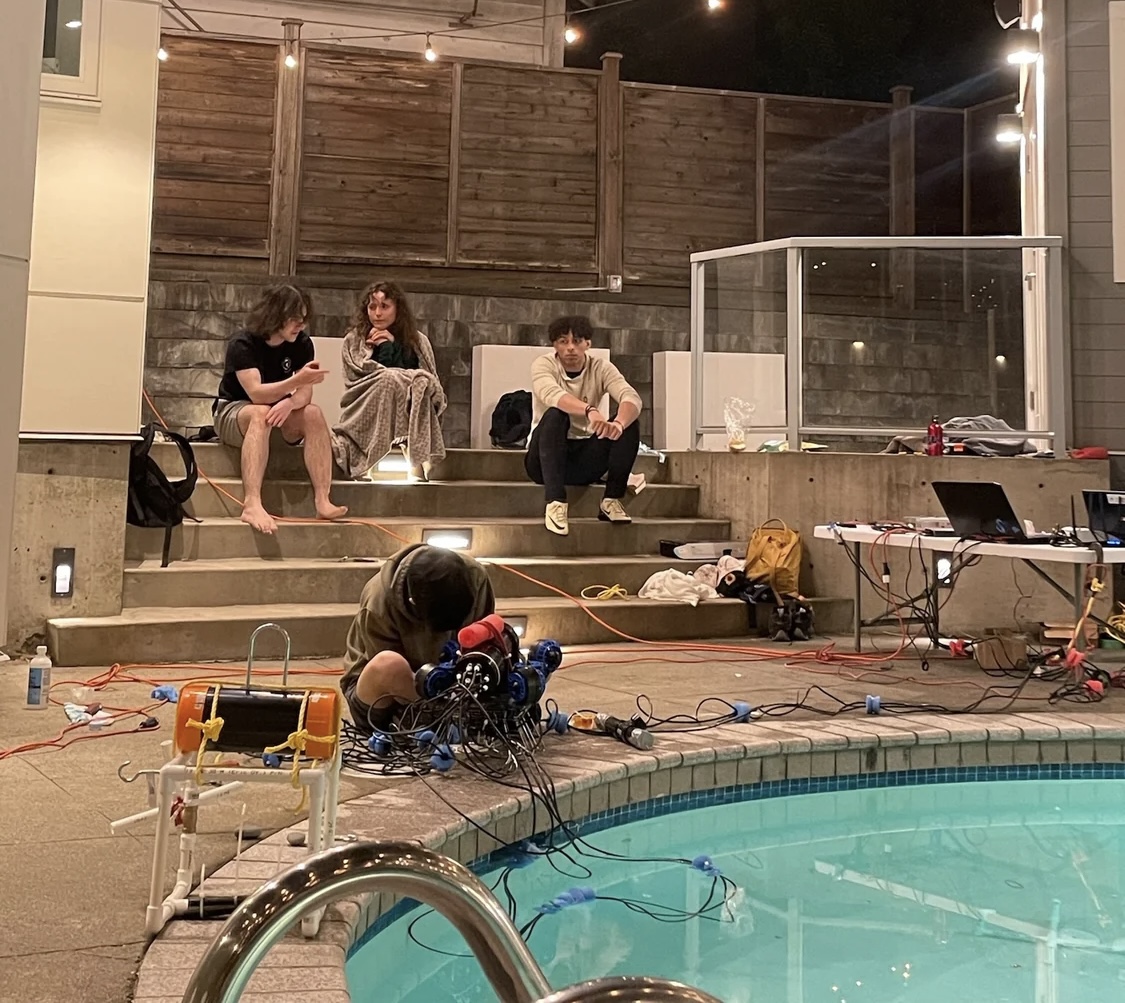
What They’ve Done: Subvision Robotics has successfully advanced ZIMA from an initial proof-of-concept into a sophisticated subsea system architecture. The engineering team has executed detailed CAD modeling, built custom power and sensing networks, and developed a specialized underwater drivetrain. This advanced mobility stack allows the rover to maintain reliable magnetic adhesion and execute precise maneuvers across curved, wet steel hulls.
This rigorous technical progression has secured over $55,000 in non-dilutive validation funding from the Ocean Startup Project, the Chang Institute, and the Leo Maddox Prize for environmental innovation. By focusing strictly on frontline maritime constraints—like fuel penalties, coating degradation, and shifting port rules—the team has already generated active pilot interest from commercial operators eager for a clean-hull baseline.
Why NVBC: Moving through the 2026 New Ventures BC Competition, presented by Innovate BC, has pushed Subvision’s team to strip away the academic jargon and face commercial realities. While it is easy for tech founders to get lost in the nuance of sensors and software, the competition has disciplined the team to clearly articulate who pays for the solution, why the market needs it now, and how to scale a defensible business.
Up Next: The immediate 12-month horizon is focused entirely on taking their current hardware assemblies into active field demonstrations. The team’s primary goal is to prove that the ZIMA prototype can reliably traverse a ship’s hull in turbulent, real-world marine conditions while gathering the performance data required to lock down formal commercial agreements. By cementing strategic industry partnerships now, Subvision is positioned to transition from an exciting engineering build into a trusted infrastructure standard for sustainable shipping.

Building for the Port, Not the Lab
Early on, Subvision Robotics learned a lesson that trips up many technical startups: an impressive piece of hardware does not automatically equal a viable business. It’s easy to fall in love with the complexity of building an underwater robot and lose sight of the commercial reality it must survive in.
Through deep customer discovery, the founders realized that shipping fleets don’t buy futuristic tech—they buy operational efficiency. If a subsea robot adds downtime or is too complicated to deploy, it’s useless to a busy port coordinator. By grounding every engineering choice in real-world constraints, Subvision avoided over-engineering and focused entirely on what matters to global trade: minimizing coating damage and maximizing clean-hull uptime.
Meet The Team

Ali Hakam
CEORead More